

Check out our latest products
![[K-Beauty] Rose Vitamin Oil to Foam | Daily Face Wash Oil Based Cleanser | Korean Rose Oil Foaming Face Cleanser | Hydrating Facial Cleanser for Dry Sensitive Skin (3.88 oz)](https://i1.wp.com/m.media-amazon.com/images/I/71sX7yIuXRL._SL1500_.jpg?w=300&resize=300,300&ssl=1)


Price
Adobe has been jacking up prices recently, and the previous best way to get both Lightroom Classic and Photoshop (the Creative Cloud Photography 20GB plan) is now unavailable to new subscribers. As with nearly all of Adobe’s software, Photoshop and Lightroom Classic are available only via a subscription that lets you install them on two computers at a time.
The Creative Cloud Photography plan costs $19.99 per month (with an annual commitment) and gets you both flavors of Lightroom and Photoshop and 1TB of cloud storage. If you want just the workflow application, the Lightroom plan costs $11.99 per month (with an annual commitment); paying a full year up front takes the monthly cost down to $9.99. This includes both versions of Lightroom and 1TB of cloud storage. If you’re not interested in Lightroom Classic at all, you can get Photoshop by itself and 100GB of storage for $22.99 per month (with an annual commitment). Frankly, I’m not sure why you would take that last option since you can get both apps and 10 times as much storage for less.
Finally, if you opt for the full Creative Cloud plan that also includes Illustrator, InDesign, Premiere Pro, and more, you pay $59.99 per month with an annual commitment. You can get Photoshop or the full suite without an annual commitment, but doing so increases the cost to $34.49 and $89.99 per month, respectively.
For comparison, Photoshop Elements, which serves up a healthy helping of both Photoshop-style editing and Lightroom Classic-style workflow and organization tools, costs $99.99 for a three-year license. It includes a lot of guidance for less technical users.
Winner: Lightroom Classic
Availability
Both apps run on macOS 13.1 or later and Windows 10 (64-bit) version 22H2 or later. They work on Arm and Intel machines running either OS. Your PC must have 8GB of RAM at a minimum, though Adobe recommends 16GB or more.
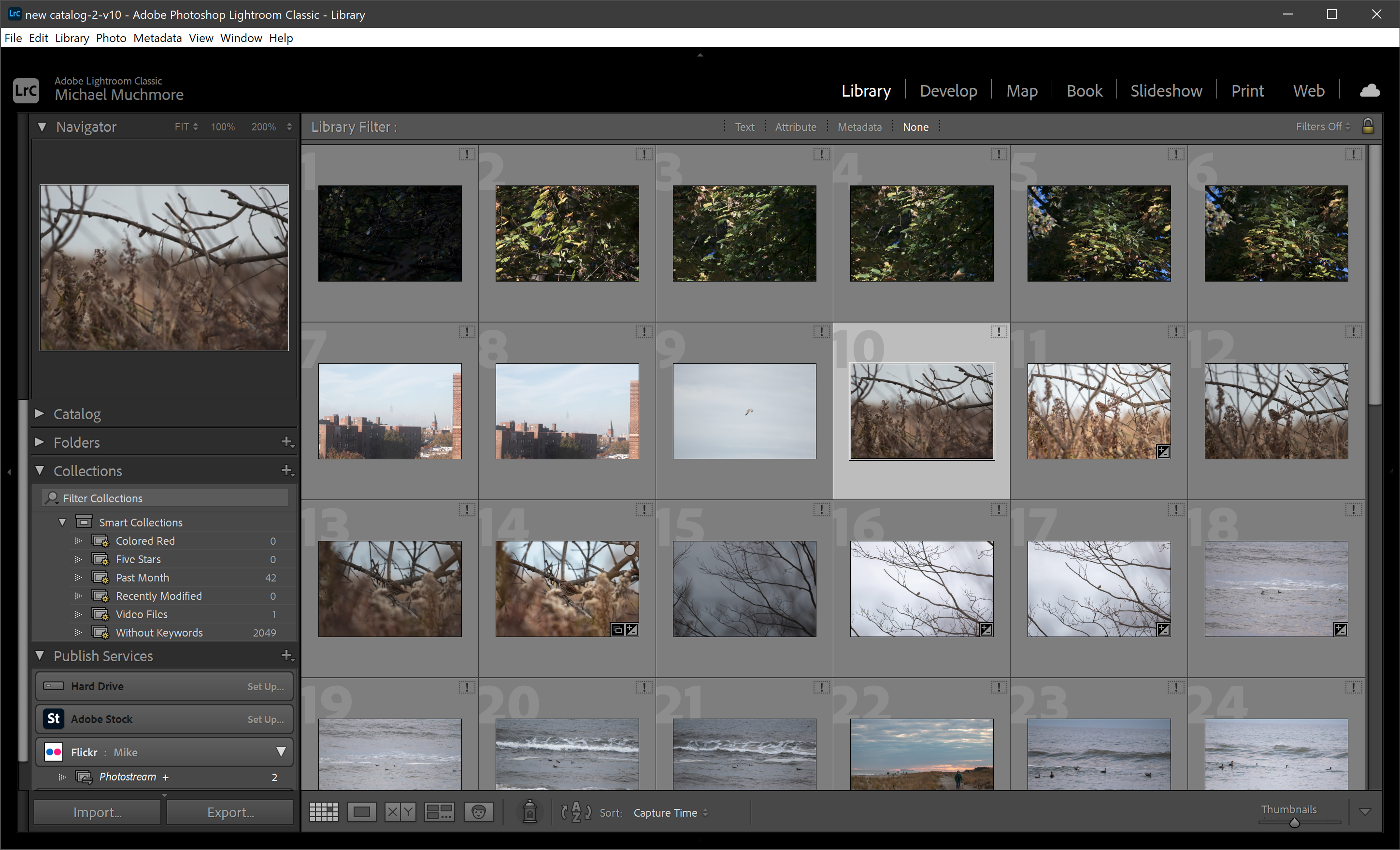
Lightroom Classic is all about working with a collection of photos you import from your camera (Credit: Adobe/PCMag)
Adobe now offers web and mobile versions of Photoshop and Lightroom, too. You must use the Chrome or Edge browsers to access the former. The Lightroom mobile app is available for both Android and iOS (this is closer in identity to Lightroom than Lightroom Classic). In contrast, the new Photoshop mobile app is iOS-only for now (Adobe plans to bring it to Android). I discuss the mobile apps in a later section.
Winner: Tie
Importing and Organization
If you’re a photographer who needs to import and organize your work on a regular basis, you don’t need to go any further in this article: Choose Lightroom Classic because it’s designed to handle workflow. What is workflow? It comprises all the steps from transferring image files from your camera’s memory card to adjusting their color, crop, lighting, and sharpness to outputting the final images either online or in print.

When you import photos into Lightroom, you can apply tags and even effects simultaneously (Credit: Adobe/PCMag)
Photoshop isn’t meant to handle importing and managing your photo collection. You can use its ancillary Bridge application for this purpose, but having a single application like Lightroom Classic makes for a more streamlined process.
Winner: Lightroom Classic
Working With Raw Image Files
Both Photoshop and Lightroom Classic can open raw camera files, which have extensions like ARW (for Sony), CR3 (for Canon cameras), and NEF (for Nikon). These files are larger than JPGs because they contain more data straight from your camera’s sensor, allowing for more powerful adjustment of lighting and color after the fact. If you shoot in JPG, your camera interprets the sensor data and delivers its best guess as to how the image should look.
If you edit a raw image file, you can change specific luminosity ranges like highlights or shadows using data from the original sensor capture that doesn’t carry over to an initial JPG rendering. This way, you can, for example, pull out the color of a bird that appears only as a black silhouette in the initial JPG version. A JPG simply doesn’t retain such information, so you might not have any way of showing that a blackbird is actually a bluebird.

Raw processing in Adobe Camera Raw (Credit: Adobe/PCMag)
In Photoshop, you can’t just open a raw camera image directly. When you start opening a raw image file, the separate Adobe Camera Raw (ACR) app pops open and loads your image. This gives you a sort of pre-editor, with adjustments for color, lighting, and sharpness. In fact, you find nearly all of Lightroom’s tools in ACR and then can open the result in Photoshop proper for further editing.
Lightroom Classic, on the other hand, lets you import raw files and start working on them without the need for an intermediary utility. Lightroom Classic and ACR both offer Adobe’s Raw Profiles, which determine how the software converts the original sensor data into an editable image. You can use a profile based on your camera or choose Adobe Color, Landscape, Monochrome, Portrait, or Vivid. Each tilts the result toward specific color and sharpness levels.
Winner: Lightroom Classic
Nondestructive vs. Destructive Editing
A key difference between a photo workflow application like Lightroom Classic and a straight-on image editing one like Photoshop is that the former keeps all your originals and stores editing changes for every photo in a database. In Lightroom Classic parlance, this database is called a catalog. This setup means that the original photo remains intact and accessible at any later time.
When you edit an image in Photoshop, you end up with a new image. You can go back to the original only if you save a copy. You can work around this Photoshop behavior with things like adjustment layers, sidecar files for raw files, and snapshots, but Lightroom implements nondestructive workflows automatically.
Winner: Lightroom Classic
Image Adjustment vs. Editing
Note the distinction between image adjustment and editing. The former means applying changes to the color, lighting, and sharpness of an entire image without adding material that doesn’t come from your camera. Editing concerns truly manipulating an image, making changes to particular areas, and adding content like text, shapes, or other images on top of the original. Lightroom Classic’s forte is adjustment, while Photoshop’s is editing. Either can do basic things like smoothing blemishes or fixing red eyes from a flash.
Lightroom Classic is perfect for things like brightening an underexposed image or bringing out colors. You can also use it to adjust sharpness and even apply lens corrections. The software does include some local adjustment tools, however. You can use a brush, gradient, or shape to change selected areas, for instance. Cropping, too, is closer to an edit than an adjustment, for which Lightroom Classic has excellent tools.

Photoshop lets you get creative with masks and gradients (Credit: Adobe/PCMag)
True creative editing is the domain of Photoshop. For example, if you want to cut someone out of a photo or place them in another image with a different background, you need Photoshop’s Select and Mask tools.
Some of Photoshop’s most dazzling tools take advantage of Adobe’s two AI technologies: Firefly (also available as a standalone web app) and Sensei. The former is a generative AI tool that creates new content for things like extending an image beyond its original borders or replacing an object in the image. Meanwhile, Sensei uses machine learning to analyze and modify images. An example of Sensei in Photoshop is its Neural Filters, which can change the apparent age of a person in a portrait, colorize a black-and-white shot, or make a photo look like a van Gogh painting.
Photoshop is technically a superset of Lightroom since it (and its ACR utility) can make any adjustments that Lightroom can. In addition, it adds selection tools and many more options, including filters, a liquefy tool, shapes, text, and vectors. But Lightroom Classic keeps getting more tools that were formerly only in Photoshop, like Generative Remove and Generative Extend.
Winner: Photoshop
Layers
One of Photoshop’s major innovations and differentiators is its support for layers. You can think of these as digital plates of glass above the original image that superimpose an effect or even another image. Moreover, Photoshop provides many blending options for layers, such as darken, dissolve, lighten, multiply, saturation, and subtract—29 in all! Serious Photoshop practitioners are skilled at using dozens of layers and even layer groups to create unique results.
Photographers can use Photoshop’s adjustment layers to apply lighting and color adjustments that they can toggle separately from any other adjustments at will. Another type of layer, the mask layer, allows you to block out parts of an image.
Lightroom, by contrast, hides layers from you. This is one of the main reasons for the program’s existence: Photographers who just want to process their photos (like in the past when they would use a darkroom) don’t want the added complexity of thinking about and managing layers.
Winner: Photoshop
Text, Shapes, Drawing, and 3D
Photoshop’s text capabilities are deep, with options like glow, stroking, and even glyph editing (changing parts of characters). If text is your main work, however, you should skip Photoshop in favor of Adobe Illustrator, which supports the text-friendly vector file format. You can resize vector images without them losing sharpness, something that’s extremely important for professionals.
Lightroom Classic’s sole text capability revolves around adding watermarks to photos. For photographers, that’s perfectly acceptable, but creative and technical image designers need at least the extra features in Photoshop.

You can use a multitude of drawing and shape tools in Photoshop, something that’s not possible in Lightroom Classic (Credit: Adobe/PCMag)
Photoshop supports shapes (as design elements) quite well. Lightroom Classic doesn’t offer anything similar. Again, however, Illustrator might be the way to go if you often work with shapes. Drawing and painting are a similar story—look to Photoshop’s myriad brush styles or even to Adobe’s excellent (and free) Fresco drawing app.
Winner: Photoshop
Recommended by Our Editors
Occasionally, Adobe adds cutting-edge features only to Photoshop. Examples include the Firefly-powered Generate Background, Generative Expand, Generative Fill, and Generate Image tools, as well as the aforementioned Neural Filters.
Adobe also updates Lightroom Classic extensively. In addition to raw file support for new camera models, Lightroom now offers automatic masking, background blur, and the previously mentioned Generative Expand and Generative Remove AI tools.
Winner: Photoshop
Tethering
Tethered shooting is when your camera, usually connected with a USB cable or wirelessly via Wi-Fi, sends photos to software on your computer as soon as you shoot them. This allows you to see the full-size images immediately and start editing, cataloging, and sharing them.

Tethered photo shooting with Lightroom Classic (Credit: TetherTools.com)
Lightroom Classic is your go-to for tethered shooting. Neither Photoshop nor non-classic Lightroom has that capability.
Winner: Lightroom Classic
Printing
Both photo applications have strong printing capabilities, with support for color profiles, output sharpening, and soft proofing. Lightroom Classic offers more in the way of layout options, including contact sheets, and it makes watermarking a simple part of the print setup. If local printing is important to you, choose Lightroom Classic over the non-Classic version; the latter doesn’t have a local printing capability.

Printing interface in Lightroom Classic (Credit: Adobe/PCMag)
Photoshop supports more file formats, such as PDF and TIFF, which professional print services prefer.
Winner: Tie
Mobile Editing
If you need to edit photos on the go, Adobe offers mobile apps for Photoshop and Lightroom. The company started offering Photoshop for iPad in 2022 and launched Photoshop for Mobile in 2025. These versions are surprisingly capable. They don’t have full feature parity with the desktop versions but integrate well with them—you can save your work as cloud documents and open them on either platform.
The Lightroom mobile apps let you edit and shoot photos from your phone, giving you excellent control over the latter. Both versions offer nearly all the adjustments from the desktop version. Note that syncing photos with the Lightroom app is more straightforward if you’re using Lightroom (non-Classic) on the desktop.
Winner: Tie
Verdict: No Wrong Choice
If you tally up the results from the above categories, here’s how things stand:
In other words, each has specific strengths, and they overlap in some areas. Choosing between Lightroom Classic and Photoshop isn’t about which product you should buy—both come with Adobe’s Photography Plan subscription—but rather which you should use. The answer may well be both.
Lightroom Classic is your go-to for getting the images off your camera card, organizing them, and fixing their color, lighting, and geometry. Stick with Photoshop for deep image manipulation that involves adding shape and text overlays, applying artistic filters, and masking people and objects. Meanwhile, if you want to process a photo you take and then make various creative edits, there’s no better combination than Lightroom Classic and Photoshop.


![[ 8 Pack ] Plastic Storage Baskets With Lids, Small Pantry Organization, Stackable Storage Bins, Household Organizers for Cabinets, Countertop, Drawers, Under Sink or On Shelves,Gray](https://i1.wp.com/m.media-amazon.com/images/I/81NMRFDwXYL._AC_SL1500_.jpg?w=300&resize=300,300&ssl=1)
![[Luxury] Kitchen Soap Dispenser Set – 16OZ Black Glass Bottle, Stainless Steel Pump, Instant Dry Tray, Waterproof Labels, Non-Slip Silicone Pad, and Dish Brush | Upgrade for Your Kitchen and Bathroom](https://i3.wp.com/m.media-amazon.com/images/I/71TQcJWiGtL._AC_SL1500_.jpg?w=300&resize=300,300&ssl=1)