
Check out our latest products
![[K-Beauty] Rose Vitamin Oil to Foam | Daily Face Wash Oil Based Cleanser | Korean Rose Oil Foaming Face Cleanser | Hydrating Facial Cleanser for Dry Sensitive Skin (3.88 oz)](https://i1.wp.com/m.media-amazon.com/images/I/71sX7yIuXRL._SL1500_.jpg?w=300&resize=300,300&ssl=1)


If you have a Samsung phone or tablet, you might be missing out on a feature that makes it a whole lot more powerful: DeX. Introduced back in 2017 as a physical product, DeX is now a software mode in which your phone or tablet powers a full-on desktop experience. You can hook it up to a monitor or TV and even use a mouse and keyboard to control a PC-like interface.
Don’t confuse DeX with Windows Phone Link, which allows a wireless phone connection to Windows 11 for access to calls, messaging, mobile apps, and photos. The main difference is that DeX doesn’t require a PC—just a screen. We’re here to show you how to use it.
What Do You Need to Use DeX?
First, you need to make sure you have a DeX-capable device. There are a lot: Every Galaxy S model, from the S8 all the way to the current Galaxy S25 lineup, supports DeX, as do all the Fold models. Oddly, the Galaxy Z Flip doesn’t offer the version I cover here, but rather a tablet-focused one that puts a desktop-like interface right on the device. Most tablets since the Galaxy Tab S4 support both types of DeX.
Earlier devices (before the S9 and Tab S5e) support just a wired DeX setup. You can check this Samsung page for details. I focus on the wireless method here since it’s the simplest and most convenient. After all, the wired connection method requires an extra piece of kit: a USB-C-to-HDMI adapter or dock. For the wireless method, you just need a display that supports Miracast screen mirroring. Most smart TVs and Windows PCs running the Wireless Display app qualify.
For reference, I used a Galaxy S21 Ultra with One UI 6, a 4K Lenovo monitor connected to a Windows 11 PC, and an LG B4 OLED TV for testing. Samsung references a no-longer-available Windows app for DeX in its help resources, but you don’t need that for either method.
How to Set Up DeX on a Galaxy Phone
Getting started with DeX is simple. Just follow the steps below:
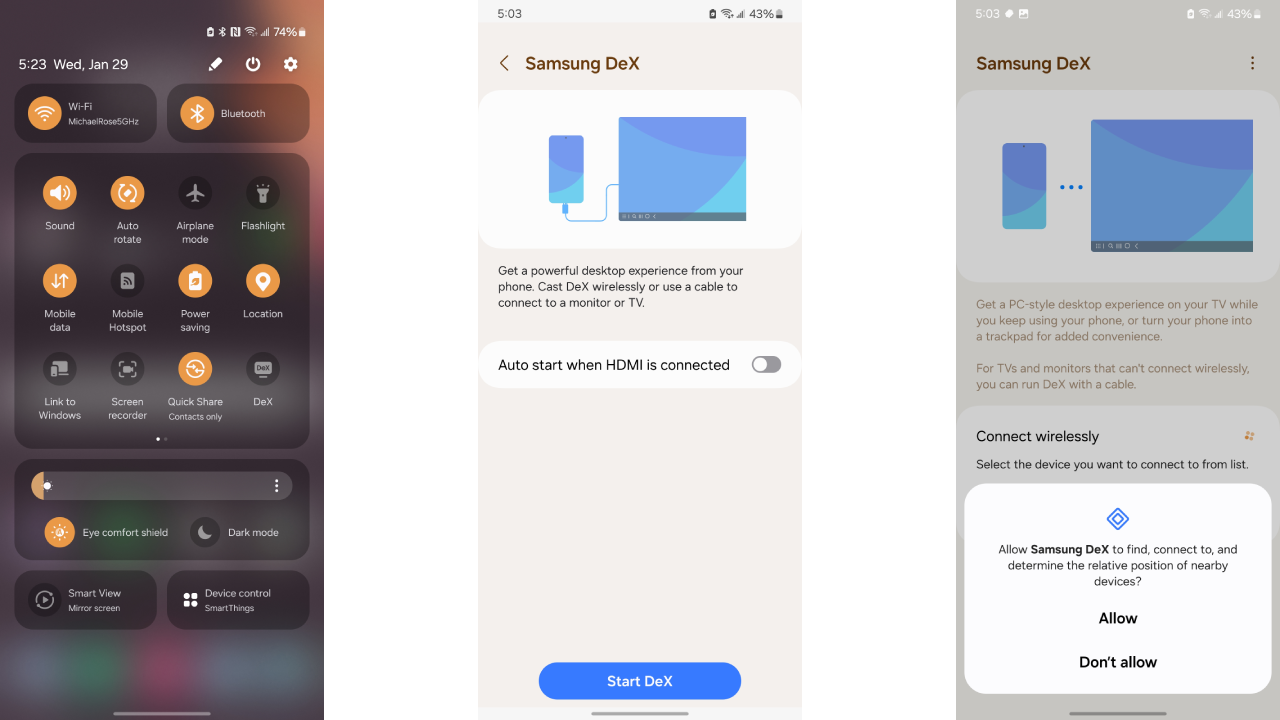
Left to right: DeX button in Quick Settings, Start DeX screen, and nearby device permission screen (Credit: Samsung/PCMag)
1. Open DeX
Open Settings from the top drop-down shade and find the DeX Quick Settings icon. Alternatively, you can search for it in Settings and select Samsung DeX or tap into the Connected Devices section.
2. Press Start DeX
The DeX connection screen includes an explanation of the feature and shows a big blue button that says Start DeX. There’s also a toggle to control whether this mode automatically starts whenever you plug in an HDMI cable to your phone. Tap the Start DeX button to continue. If you’re trying to project wirelessly to a Windows PC, you need to turn off Windows Phone Link at this stage.
3. Allow DeX to Access Nearby Devices
Next, you need to allow DeX to find and connect to local devices.

Left to right: DeX Display choices, warning message, and Start Now button (Credit: Samsung/PCMag)
4. Choose Your Display
At this stage, you see the same list of devices you would if you were trying to project to a Miracast wireless display for screen sharing. In this case, however, you are setting up a widescreen desktop interface. Select the display device you want to use to continue.
5. Accept the Warnings
On the next page, read the warning message and tap the Start button. There are several caveats to using DeX, which this page explains. (It increases battery usage and, therefore, heat, for one.) The part about foreground and background apps closing didn’t happen during testing; I could still use apps on my phone without issues.
6. Accept One Final Warning
Give DeX permission to handle your phone data when it asks. This isn’t something to worry about if you’re using your own devices. Then, tap Start Now.

(Credit: Samsung/PCMag)
7. Enjoy the Big-Screen Experience
Behold! Your mobile screen is now on your big screen! If you’re projecting to a TV, you won’t see the Windows taskbar, of course. You can also make DeX on a PC full-screen so that you see only its interface.
It’s a pleasure watching Instagram videos on a huge screen, for instance, as opposed to squinting at my phone. Audio also sounds better on my desktop’s bigger speakers. On my LG B4 OLED TV, the interface looks the same, just with the additional benefit of being able to use the remote’s pointer as well as the phone screen for navigation.

(Credit: Samsung/PCMag)
8. Use Your Phone as a Trackpad and Keyboard
One clever aspect of DeX is that you can use your phone as a trackpad and keyboard for the big screen. The only way I could get this to work was to tap the relevant entry in the phone’s notifications area. You can switch to another app from the DeX app and then go back to it whenever you want. Doing so doesn’t switch the app that appears on the external display.
Recommended by Our Editors
What’s It Like to Use DeX?
The phone’s trackpad interface is minimal, but an on-screen keyboard helpfully pops up if you tap into a text-entry box. It also supports landscape orientation. Double-tapping the exclamation point icon will access a tutorial that details a generous selection of three- and four-finger gestures.
Connecting to a wireless mouse and keyboard is a simple matter of pairing them via your phone’s Bluetooth settings. However, controlling the cursor—even with a wireless mouse—isn’t as easy as it is with a PC because of lag.

(Credit: Samsung/PCMag)
The DeX interface is attractive and functional; it reminds me of ChromeOS. The selection of app icons on the desktop differs from that on your phone’s home screen, but you can use the Apps button to see everything. Running apps appear as icons in the center of the toolbar at the bottom of the screen, and you can open and minimize windows by clicking on them. In a nice touch, hovering over an icon in the bottom taskbar shows a thumbnail of the app. You also get the standard Android app-switching buttons.
Apps that are normally in narrow portrait orientation can expand to take over the full screen. You can even use the phone’s biometric authentication (face or fingerprint) methods to unlock secure apps.
How Well Does DeX Work?
Samsung’s DeX mode is a viable option if you want a bigger screen than your phone offers, either because you don’t have a standalone PC or are traveling and have access to just a smart TV in a hotel room.
I still prefer using a standard PC, but if I were in one of the situations above, I’d certainly turn to Samsung DeX. Working on a Word document, for example, as I did to write this article, is much more pleasant on a large screen.
For alternatives to using your Android phone on a bigger screen, check out our articles on how to connect them to your TV and Windows 11 PC.

Like What You’re Reading?
This newsletter may contain advertising, deals, or affiliate links.
By clicking the button, you confirm you are 16+ and agree to our
Terms of Use and
Privacy Policy.
You may unsubscribe from the newsletters at any time.

About Michael Muchmore
Lead Software Analyst

Read the latest from Michael Muchmore


![[ 8 Pack ] Plastic Storage Baskets With Lids, Small Pantry Organization, Stackable Storage Bins, Household Organizers for Cabinets, Countertop, Drawers, Under Sink or On Shelves,Gray](https://i1.wp.com/m.media-amazon.com/images/I/81NMRFDwXYL._AC_SL1500_.jpg?w=300&resize=300,300&ssl=1)
![[Luxury] Kitchen Soap Dispenser Set – 16OZ Black Glass Bottle, Stainless Steel Pump, Instant Dry Tray, Waterproof Labels, Non-Slip Silicone Pad, and Dish Brush | Upgrade for Your Kitchen and Bathroom](https://i3.wp.com/m.media-amazon.com/images/I/71TQcJWiGtL._AC_SL1500_.jpg?w=300&resize=300,300&ssl=1)